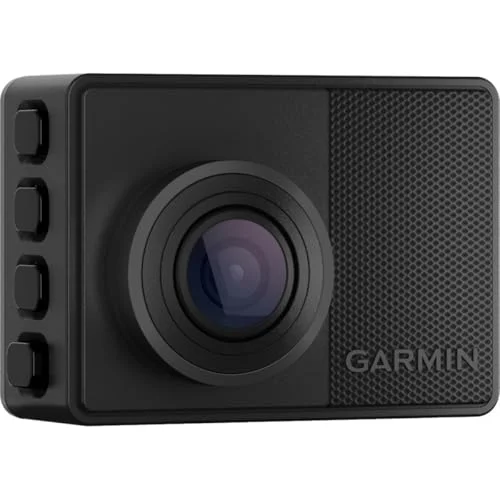
Who is the Garmin 67W for?
The 67W is the right camera if you want sharp footage and a discreet install without paying a 4K premium. It suits the driver who wants the camera to disappear, who values a wide field of view to catch incidents at junctions and side roads, and who likes the idea of flagging a clip hands-free with a voice command. The tiny body and magnetic mount make it the easiest camera here to fit and forget, and the 1440p footage is more than sharp enough for everyday evidence.
It is less suited to the driver who specifically wants 4K for reading distant plates, or who needs an on-camera touchscreen to review footage on the spot, since the 67W has only a small 2-inch screen and no touch. If maximum resolution is your priority, the Nextbase 622GW is the camera to choose. But for the best balance of footage, features and price, the Garmin is hard to beat.
How the Garmin 67W performs
The wide lens advantage
The 67W's standout feature is its 180° field of view, far wider than the 140° on most cameras. This matters more than the spec sheet suggests. A wide lens captures vehicles cutting in from the side, incidents at junctions, and cyclists or pedestrians at the edge of the road that a narrower camera would simply crop out of shot. In real traffic, the difference between catching a side-swipe and missing it often comes down to exactly this. The trade-off is slightly more distortion at the very edges, but for evidence the extra coverage is well worth it.
Video quality
At 1440p the 67W produces sharp, clean daytime footage with plates and details clearly legible at sensible distances. It sits a step below the 4K cameras for reading plates far ahead, but for the great majority of incidents, which happen close to your own car, it captures everything you need. At night it is solid: detail holds up under street lighting and you can identify vehicles and read close plates, though it is not a low-light specialist like the Thinkware U3000.
Voice control and driver assist
Voice control is genuinely useful, not a gimmick. You can save a clip, start or stop recording or take a still with a spoken command, which means you can flag an incident the moment it happens without taking your hands off the wheel or your eyes off the road. In our testing it works reliably even with road noise. The 67W also includes Garmin's driver-assist alerts, such as forward-collision and lane-departure warnings, which add a layer of safety on top of the recording.
Build and fitting
The 67W is the easiest camera here to fit. The magnetic mount lets you position it behind the mirror in seconds and snap it off when you want to take it with you. The one caveat we would flag is that, in very hot weather, the adhesive mount can occasionally need re-seating, so it is worth fitting it carefully on a clean, warm screen. Otherwise, this is a fit-and-forget camera in the best sense.
The honest downside: no touchscreen, small body
The 67W's compromises are the flip side of its strengths. The tiny body means a small 2-inch screen and no touch control, so you set it up and review footage through the Garmin Drive app on your phone rather than on the camera itself. For most people that is fine, but if you prefer to scrub through clips on a proper touchscreen in the car, the Nextbase 622GW or 322GW will suit you better. None of this changes the core value: for sharp, wide footage in a camera that disappears, the Garmin remains the smart buy.